Some of the best-known companies in the world don’t sell anything directly. Instead, they own other businesses that do. When you use Google Search, watch YouTube, or buy car insurance from GEICO, you are using a product from a company that sits under a larger parent. That parent is often a holding company.
In this guide, we explain what a holding company is and how it works.
What Is a Holding Company?
A holding company is a business that owns a controlling interest in one or more other companies, called subsidiaries. Its main role is to own and oversee those businesses, while each subsidiary usually runs its own day-to-day operations.
How a Holding Company Works
A holding company sits at the top of a group of businesses. It typically owns enough of each subsidiary’s shares to control its major decisions, such as who leads it and how it is funded.
Here is how the roles usually break down:
- The parent (holding company) sets overall direction, appoints leadership, and decides where to invest resources across the group.
- The subsidiaries run their own products, customers, and daily operations, often under their own brand names.
- Shared functions such as finance, legal, and HR may sit at the parent level and support every business in the group.
Each subsidiary is usually its own legal entity. That means it can sign contracts, hire employees, and serve customers in its own name, while still being part of the larger group.
Why FIRY Uses This Structure
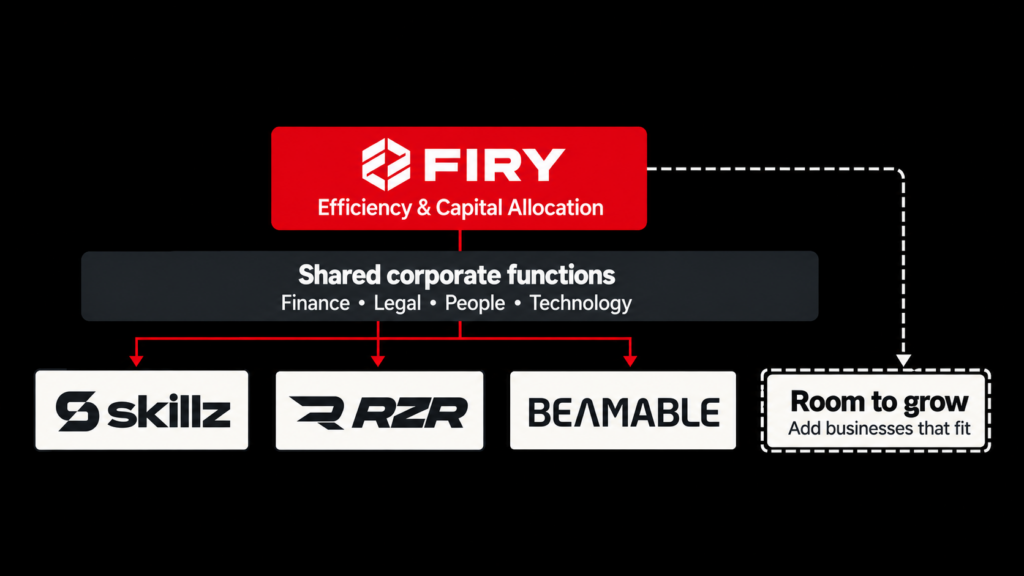
Companies choose a holding company structure for several practical reasons. For FIRY, two matter most: efficiency and capital allocation.
Room to grow: A holding company can add a new business segment without restructuring the ones it already has.
Efficiencies: Our business segments share one set of corporate functions, such as finance, legal, people, and technology, instead of each one building its own. As our founder and CEO Andrew Paradise put it when we introduced FIRY, the model is “one overhead model underneath three businesses. Not three cost bases.”
Capital allocation: As the parent company, FIRY decides where to invest across the group. We can direct resources to the business segments with the strongest opportunities and add new businesses when they fit. That is how FIRY came together: Skillz first, then RZR in 2021, then Beamable in 2026.
Complementary businesses: Our three business segments are built to work together. In Andrew’s words, “Our three complementary businesses serve the same customer: the game developer.” Skillz, RZR, and Beamable each support that customer at “three different moments in their journey.”
Separate brands: Each business segment keeps its own name and identity, which matters when they serve different audiences.
How FIRY Is Structured
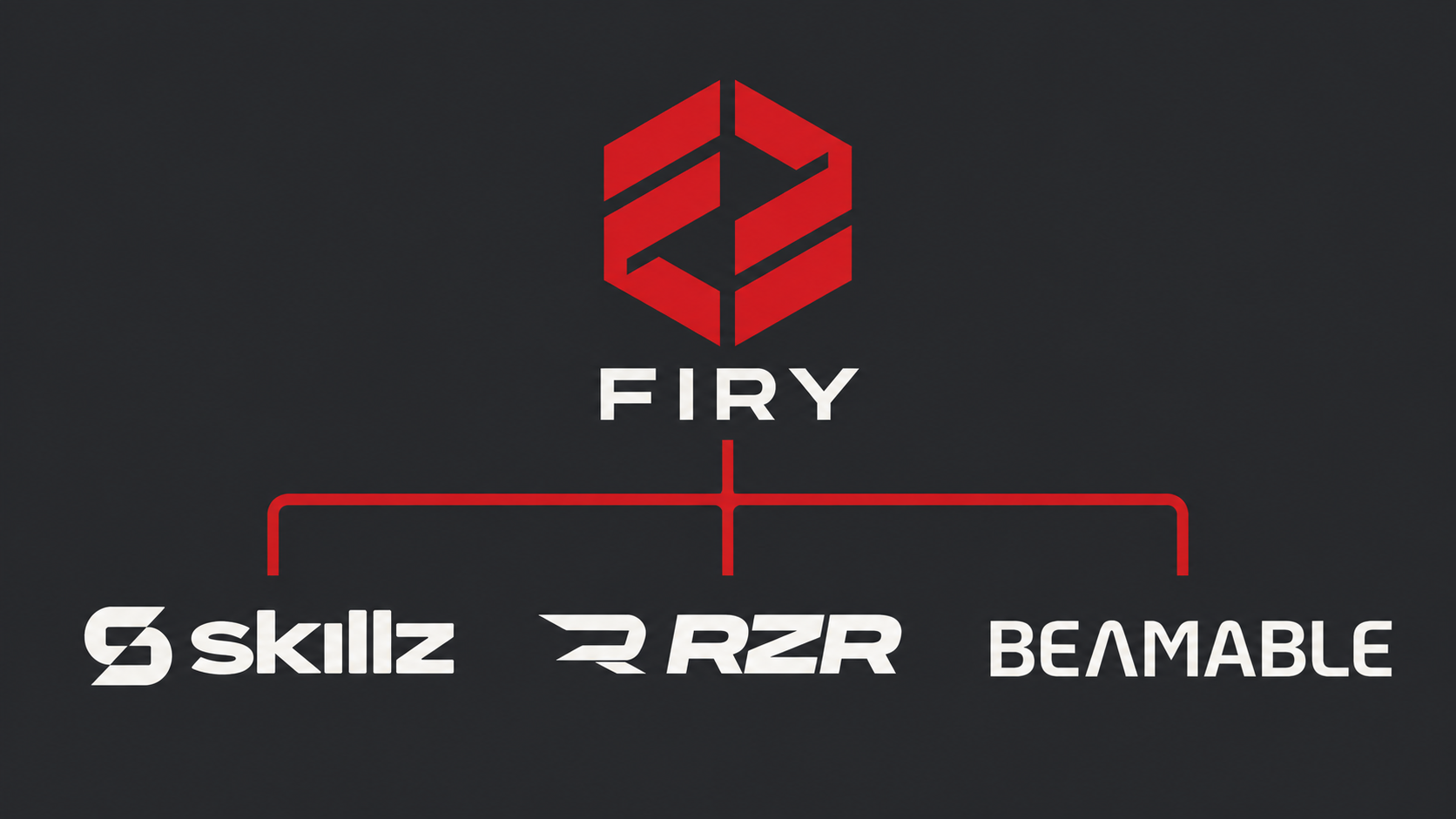
FIRY is a technology holding company. We are the parent of three businesses, each with its own team, products, and customers:
- Skillz is a skill-based mobile gaming platform that lets players compete in games against others of similar skill.
- RZR is an AI-powered AdTech platform that helps advertisers reach the right audiences.
- Beamable provides developer tooling for game studios, helping them build and run their games.
Each business keeps its own brand and focus, while FIRY provides shared leadership and support across the group.
Frequently Asked Questions
Does FIRY make its own products?
Our products come from our three business segments: Skillz, RZR, and Beamable. As the parent company, FIRY provides shared leadership and corporate functions and decides where to invest across the group.
Do FIRY’s business segments keep their own brands?
Yes. Skillz, RZR, and Beamable each keep their own names, products, and customer relationships, while operating as part of FIRY.
How do FIRY’s business segments work together?
Our business segments are complementary. As Andrew Paradise, our founder and CEO, explains, “Our three complementary businesses serve the same customer: the game developer.” Skillz handles monetization and competition, RZR handles user acquisition and retargeting, and Beamable provides developer tooling that helps studios build and run their games.
Why is FIRY structured as a holding company?
Efficiencies and capital allocation. Our business segments share corporate functions like finance, legal, and people operations instead of each building their own. As the parent company, FIRY can direct resources to the business segments with the strongest opportunities and add new businesses when they fit.
Is FIRY publicly traded?
Yes. FIRY is listed on the New York Stock Exchange under the ticker FIRY. We were previously known as Skillz Inc. and rebranded to FIRY in June 2026.